Are you on the hunt for great sounding jazz piano chords?
If so, you’ve likely encountered chord symbols like Dbsus13b9 or F#△9b5 – hieroglyphic notations that overwhelm even experienced players, and are downright intimidating for jazz piano beginners looking to learn their first jazz chords.
Or maybe you’ve found a trusty guide on the interwebs that promises to decipher every possible jazz piano chord out there, but provides no context on how to actually play them to capture that authentic jazz sound.
Well today, I’m going to fix that for you.

Are you on the hunt for great sounding jazz piano chords?
If so, you’ve likely encountered chord symbols like Dbsus13b9 or F#△9b5 – hieroglyphic notations that overwhelm even experienced players, and are downright intimidating for jazz piano beginners looking to learn their first jazz chords.
Or maybe you’ve found a trusty guide on the interwebs that promises to decipher every possible jazz piano chord out there, but provides no context on how to actually play them to capture that authentic jazz sound.
Well today, I’m going to fix that for you.
5 Easy Jazz Piano Chords That Sound Great
By: Adam Maness | Jazz Pianist & Managing Director @ Open Studio
This blog is perfect for jazz piano beginners and anyone looking to enhance their piano chords with accessible jazz chord fundamentals. I’ll break down 5 Easy Jazz Piano Chords That Actually Sound GREAT and provide you with real tips – used by the pros – to help you practice and lock them in for good.
But before we even touch the keys, we’ve got to talk about the most important element in jazz: RHYTHM…
Get in the Groove: The Charleston Rhythm
None of this matters if you can’t get into the groove. The rhythms are what makes jazz, well, jazz! And one of the oldest and easiest rhythms to start with is called The Charleston. It’s a simple yet powerful syncopated pattern that jazz pianists use to help drive the swing feel when comping (or more simply, playing jazz piano chords).
On paper The Charleston Rhythm consists of a dotted quarter note followed by an eighth note, like this:

Here’s a quick way to get into it:
- Count it: ONE-and-two-AND-three-and-four-and…
- Clap it: on just the “ONE” and the “AND” of two.
- Swing it: swing the eighth note so the off-beat (“AND”) is delayed slightly.
Once you’ve got the groove in place, you’re ready to dive into our first jazz piano chords.
Chord #1: D Minor 9
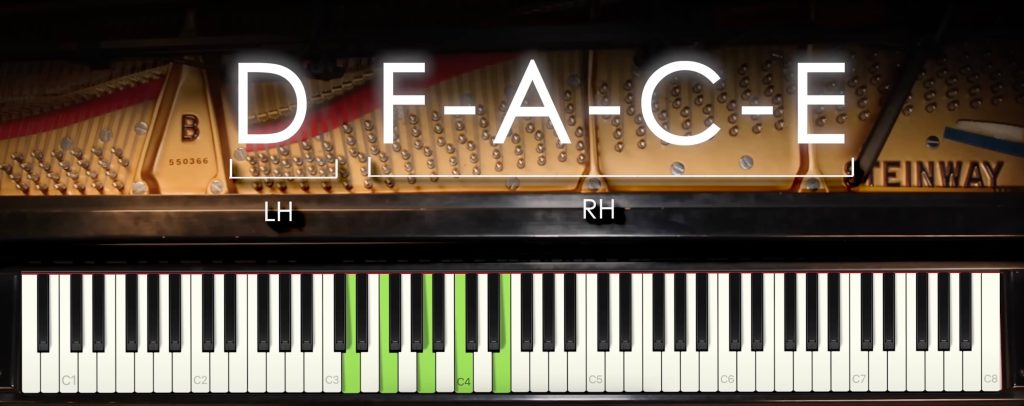
Our first jazz chord is a D minor chord. Technically, it’s a D minor 9 chord and you’ll most likely see it written as Dm7, D-7, Dmin7 in jazz charts – now isn’t that confusing! But we don’t need to know any of that naming or notation mess. You just need to know how to build it:
- Left Hand: Start with the D below middle C.
- Right Hand: Skip a note and add an F, skip a note to A, skip another note to C, and skip one more note to E.
- Left Hand: Take the D and drop it an octave for a fuller sound.
Now you’ve got this beautiful, resonant D Minor 9 chord. Practice the chord with our simple Charleston rhythm to feel the groove and voicing in your fingers.
Chord #2: G7 with Extensions
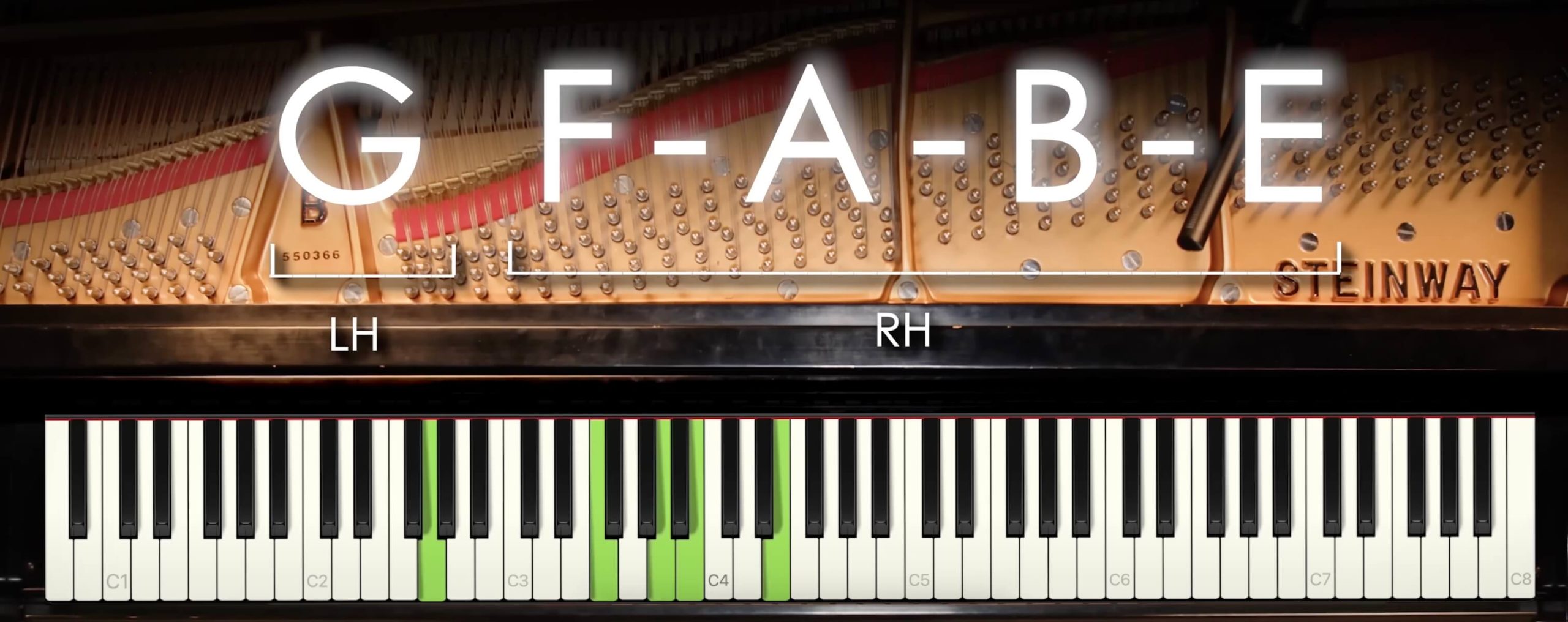
The second chord of our jazzy progression is a G7 chord, and we only have to move ONE note in each hand to get there!
- Right Hand: Move the second-to-top note, the C, down a key to B. That’s it!
- Left Hand: Move the root D down five keys to G.
Now technically this is a G7 with extensions, a G13 chord specifically, because we’ve added the 9th (A) and 13th (E) for color, but again, no need to know any of that. It’s just G7 – and it sounds great.
Practice going between the Dmin7 and the G7 using the Charleston rhythm. Back and forth until it feels natural and locked in.
Chord #3: C Major 9
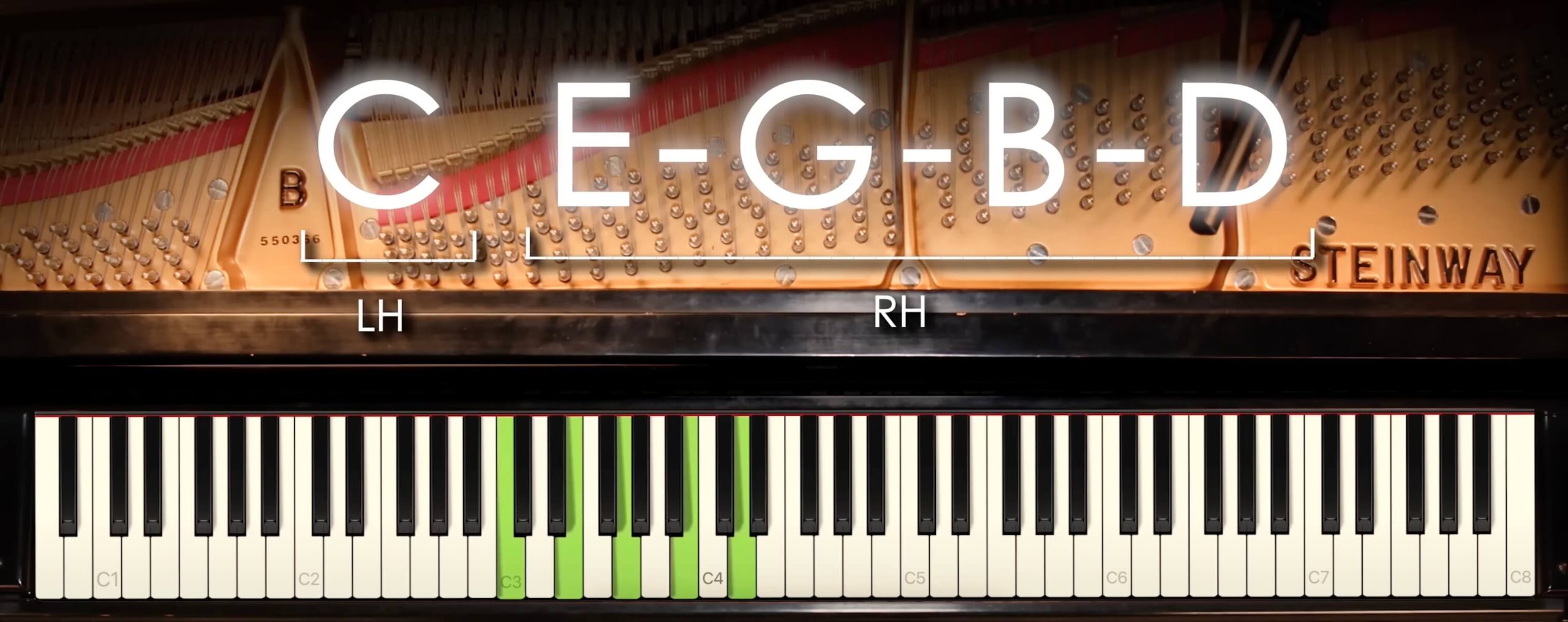
The third chord of our progression is a C Major chord. Since we’re in the key of C, this is also our tonic, or our home base. We’re going to build it the same way we built the D minor 9 chord – from the root up.
- Left Hand: Play the C below middle C
- Right Hand: Skip a note to E, skip a note to G, skip another note to B, and skip one more note to D.
- Left Hand: Drop the C down an octave, just like the D Minor
That’s a CMaj9 chord! It’s beautiful, it’s major, it’s bright, it’s airy!
Practice with the Charleston Rhythm, first the CMaj9 voicing alone, then transitioning between the G7 and C, then all 3 in a progression: Dmin7 – G7 – C
Chord #4: F Major with Extensions

The next chord in the progression is our F major chord, we’re going to get there the same way we got from D Minor to G7 – moving just one note in each hand from our CMaj9 chord:
- Right Hand: Move the second-to-top note, the B, down a key to A.
- Left Hand: Move the root C down five keys to F.
This is our FMaj13 chord with pretty sounding 9th (G) and 13th (A) extensions. You’ll generally just see this notated as an Fmaj7 in a chart, but you can just think of it as a big, full F major sound.
Practice going back and forth between the C Major and F Major chord using the Charleston rhythm. Notice how it feels in your hands and ears, it may sound familiar as the Tonic to IV-chord vamp underlies A LOT of pop, funk, gospel, R&B, jazz, and more.
Chord #5: A7 with Alterations

Now here’s our last chord. It’s an A7 chord, but it’s got a bunch of Altered notes added to it that make it CRUNCHY! We have a b9 (Bb) and a b13 (F) – all those symbols again, right? Again, we don’t need to know any of that, we just need to know that it sounds super tense.
Let’s talk how to build this A7b9b13 chord.
- Right Hand: start on G, add a B-flat above that, go up a minor third to C#, and up a major third from that to F.
- Left Hand: root the chord with A
Play this big, crunchy A7 chord. Feel how unstable it feels. You’re probably tensing up right now, because this chord doesn’t want to stay here. It’s begging for a resolution. And where does it want to go?
That’s right, back to the top! The A7b913 chord leads perfectly back to our Dmin9 chord. How great is that?
Now we’re ready to practice the full progression. Groove along with me and Kaleb using the Guided Practice Session video above!
The Pro’s Practice Secret: Transposition
Now the cool thing about this is, if we want to lock this chord progression in for good, we just have to do ONE thing. It’s what I was talking about at the beginning of this blog. This is the technique that all the professional musicians you know use to get ideas, language, and voicings, into their playing.
We’re going to TRANSPOSE this right away.

Transposing means moving the entire progression to a different key. We’re just going to transpose this progression from C to the key of F.
We’re not going to think too hard about it either. Try to hear your way through, remember the fundamental chord building, and the simple movements between the chords in the progression.
From C to the key of F is a perfect fourth, which means our first chord is a G minor (Gmin9). Build it just how we built our D Minor, but this time we’re using notes from F Major (hint: there’s a Bb).
Practice hearing your way through the progression out of time, before adding in the Charleston Rhythm – and grooving along with me and Kaleb.
Want These Chords in All 12 Keys?
Download the FREE PDF EBOOK and learn these 5 Easy Jazz Chords in all 12 keys!

Meet Your Instructor
As Open Studio’s Managing Director, Adam Maness develops the curriculum of all of the courses, in addition to teaching his own popular course like Magic Voicing System, Piano Fingering Independence and more.
Adam is a versatile pianist, arranger, composer, and producer whose performances, original compositions, and arrangements have been featured on numerous recordings and on national and international radio and television broadcasts. He is best known as co-founder and composer for the genre-bending chamber ensemble, The 442s.