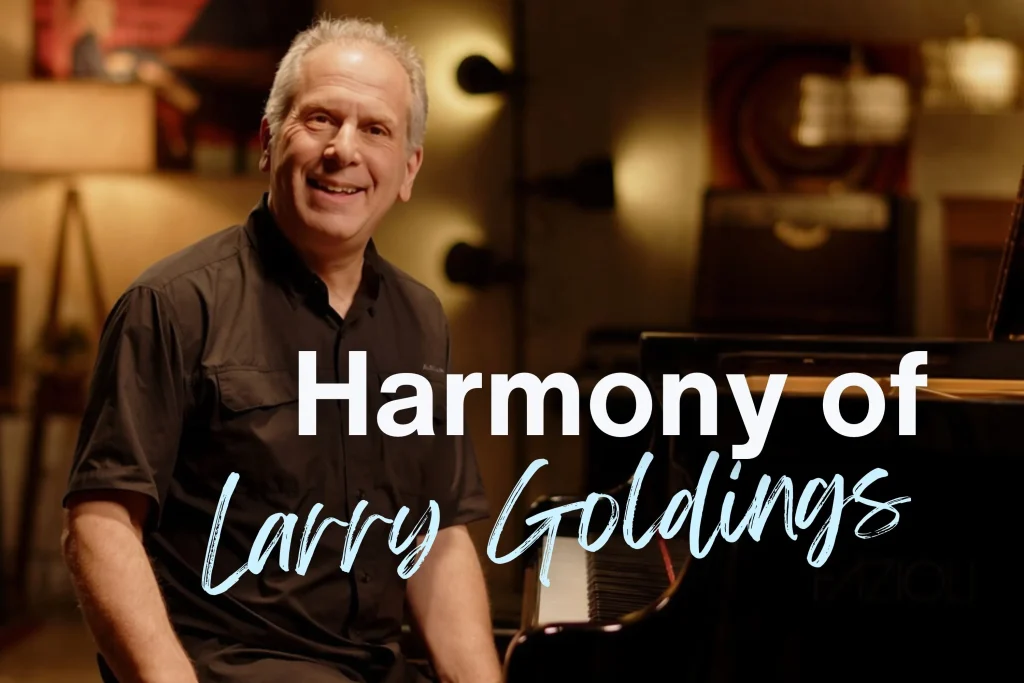
Harmony of Larry Goldings
Larry opens up how he thinks at the piano: how he hears harmony, builds voicings, and turns a simple melody into something that sounds like it could only have gone that way.
Step into Larry’s studio
Big sounds from a few well-chosen notes
Larry learned harmony from George Shearing records, Art Tatum, Bach chorales, drills from Jaki Byard, and lessons with Keith Jarrett as a teenager. In these lessons he shows you the concepts he still works with every day, and you’ll come away able to:
- Make I-IV-V sound like a whole world with open, ringing voicings, smooth inversions, and one well-placed added note that turns a basic progression into something rich.
- Reharmonize any melody, note by note with the Shearing and Tatum idea that any two outer notes can be harmonized, using chromatic, circle-of-fifths, and third-in-the-bass approaches.
- Get rich colors from triad pairs, stacking two simple triads into Lydian, sus, and altered sounds you can voice in open, pianistic shapes.
- Move between distant keys in five moves or fewer with Bach-chorale voice leading, and turn the exercise into the start of your own tunes.
- Play outside with a logic, building lines and voicings from intervals, shapes, upper-structure triads, and Slonimsky’s tritone mirror.
- Make a two-chord vamp come alive by thinking melody first, then shaping the mood with sixths, clusters, open fifths, and a lower voice with its own melodic life.
- Arrange the songs you love, from Jimmy Webb to Paul McCartney, by studying the composer’s intent first and then finding your own voice in it.
- Write melodies that feel inevitable with a composition exercise Larry learned from Keith Jarrett.
Every lesson is also a composing prompt. As Larry puts it, these exercises make you go, “Hey, that’s a good idea,” and good ideas are what you’ll carry back to the piano for years.
In Larry’s words
How he thinks about the music
“Any two outer notes can be harmonized.”
“There’s always a way to get from point A to point B.”
“I love the term inevitable, because it connotes that there’s no one right answer.”
Course contents
Ten lessons, from voicings to finished arrangements
- Lesson 1 I-IV-V I-IV-V in every guise: smooth inversions, open two-handed voicings, added nines and sevens, plus the circle-of-fifths drills Jaki Byard gave Larry.
- Lesson 2 Common Tones Hold one note and hear it become the root, third, fifth, or seventh of chord after chord, for writing and free improvisation.
- Lesson 3 Shape Voicings Fourths, stacked fifths, upper-structure triads, and the tritone mirror as fresh material when bebop lines start to feel like a rut.
- Lesson 4 Triad Pairs Two simple triads, one bigger sound. C and D for Lydian, C and B♭ for sus, C and F♯ for an instant altered color.
- Lesson 5 Modulation F major to E major in five moves. Bach-chorale voice leading and Max Reger’s Modulations as a doorway into new tunes.
- Lesson 6 Shearing Harmony Harmonizing every melody note, from Shearing’s “I Can’t Get Started” to a gloriously over-the-top “Happy Birthday.”
- Lesson 7 Inevitable Melody Exercise The melody-finishing exercise Keith Jarrett gave Larry as a teenager, played head to head with Adam Maness.
- Lesson 8 By the Time I Get to Phoenix Glen Campbell’s hit next to Jimmy Webb’s own richer changes, and how Larry builds an arrangement that honors both.
- Lesson 9 Vamp Like A Pro A D minor to G minor vamp with a live band. Lead with the top-voice melody, then color it with open triads, sixths, clusters, and a second inner voice.
- Lesson 10 I Will Paul McCartney’s melody with thick one-handed chording, register shifts, and two-voice conversations over the original bass line.

Meet your instructor
Larry Goldings
Pianist, organist, and composer Larry Goldings leads a celebrated organ trio with Peter Bernstein and Bill Stewart and has toured and recorded with James Taylor since 2001. He has worked with Jim Hall, Maceo Parker, John Scofield, Jack DeJohnette, Pat Metheny, Michael Brecker, and John Mayer, and Trio Beyond, his group with Scofield and DeJohnette, earned a Grammy nomination.
His film and TV music includes Space Cowboys, Funny People, and This American Life. He studied with Keith Jarrett as a teenager and drilled harmony with Jaki Byard, and his playing still carries those lessons: set up an idea, then finish it in a way that feels inevitable.